
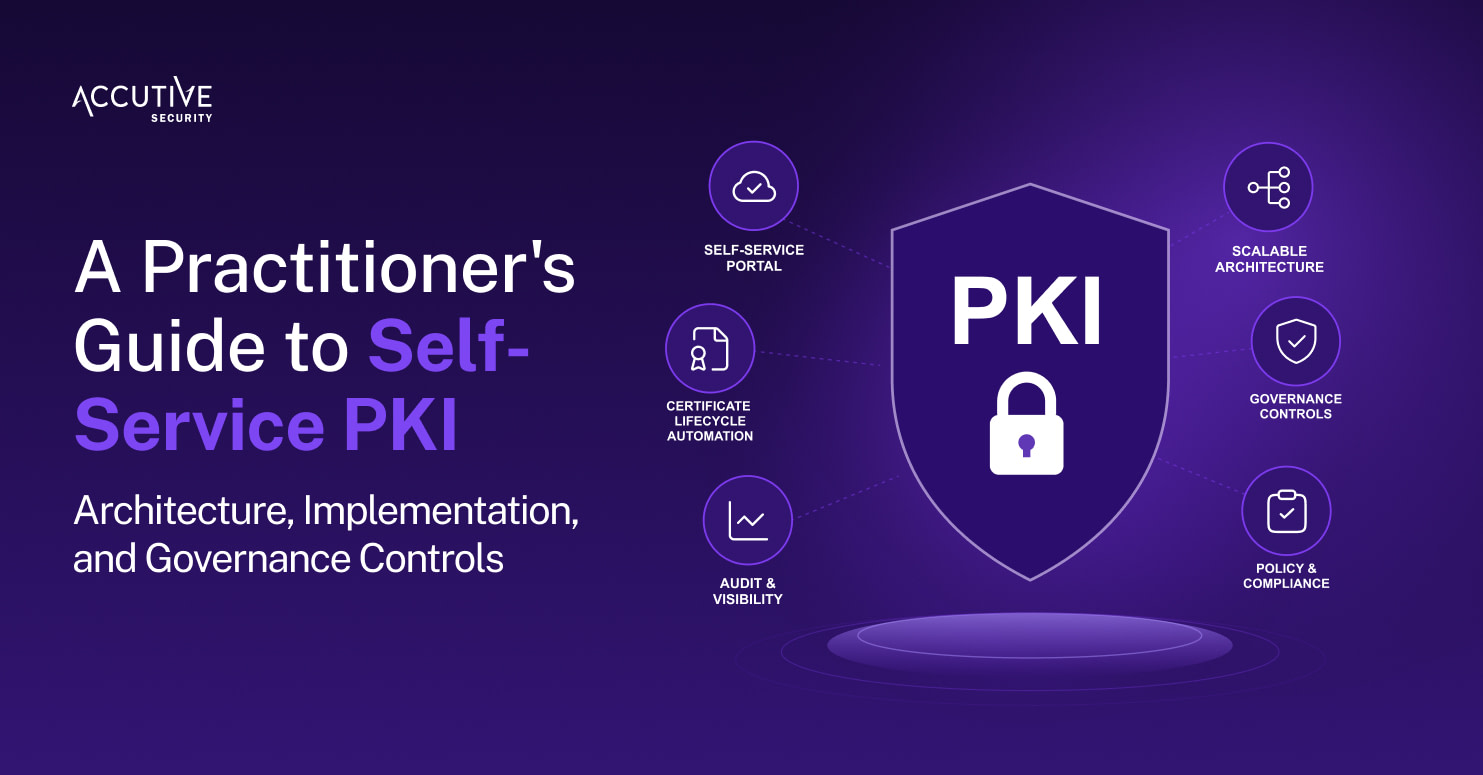

Organizations now manage an average of 114,000+ internal certificates. And in most enterprises, every certificate request still travels through the same place: a small central team, usually through a ticket queue.
That ticket-driven model carries compounding friction. Developers wait days for certificates that should take minutes. Security teams spend their time processing requests rather than designing controls. And when requests get routed around the queue, the team loses the visibility it was trying to protect.
Self-service PKI addresses this directly. It is a model where application, DevOps, and infrastructure teams request, renew, and retrieve certificates themselves through a portal, an API, or an automation protocol inside policy guardrails that the PKI team defines centrally. The central team still owns the policy; the platform enforces it at issuance time instead of implementing it through human review of individual tickets.
Manual PKI Doesn’t Scale Anymore.
A PKI & CLM Assessment shows where your risks are-and how to fix them.
The Benefits of Self-Service PKI
The operational case for self-service PKI is straightforward, but the governance case is equally strong, which is where most conversations in this space get stuck.
- Issuance speed. A developer or infrastructure engineer submitting a request through a self-service portal or calling an ACME/REST endpoint gets a certificate in minutes, not days. That speed matters most during incidents, deployments, and scaling events, exactly the moments when a multi-day queue creates real risk. The PKI team gets back the time previously spent triaging and processing requests.
- Reduced incentive for shadow certificates. When the sanctioned path is the fastest path, teams have less reason to generate self-signed certificates or order unauthorized public CA certificates outside the inventory. Self-service reduces the incentive for this behavior; it does not eliminate it, so complementary controls still matter.
- Programmatic policy enforcement. Key sizes, validity periods, subject alternative names, and naming conventions are baked into certificate templates at the platform level. Every certificate issued through the system conforms to policy by construction, regardless of who submitted the request or who was on shift when it was processed.
- Certificate ownership by default. Every certificate issued through a self-service platform is recorded with a requester identity, team tag, and application owner at issuance time. That metadata reduces the risk of unnoticed expirations on orphaned certificates, and it provides a searchable, auditable inventory that manual processes rarely produce.
- PKI team leverage. With request processing off their plate, the central team focuses on designing policy, reviewing templates, and governing the platform. This reallocation is the only staffing model that remains viable at 47-day certificate lifetimes. Once issuance is automated, the team’s workload no longer scales with certificate count.
- Audit readiness. Every issuance, renewal, approval, and revocation event is logged centrally with the requester’s identity attached. For security and compliance teams preparing for PCI DSS 4.0.1, HIPAA, or internal audit cycles, that log helps achieve audit readiness with ease.
How Self-Service PKI Works: The Building Blocks
A self-service PKI model rests on four components. Understanding how they fit together makes the implementation path easier to follow.
- Request interfaces. Humans request certificates through a web portal; pipelines and automated workloads use REST APIs or enrollment protocols. ACME handles TLS certificate automation well across web servers, load balancers, and cloud-native services. SCEP serves network devices and MDM-managed endpoints where ACME clients are impractical. EST offers stronger identity binding via mutual TLS and is gaining adoption as organizations move away from SCEP’s static challenge-password authentication model. For organizations that run ServiceNow or similar ITSM platforms, a ticketing integration lets teams request certificates without leaving the systems they already use, meeting teams where they work tends to drive adoption.
- A policy engine. Certificate templates define everything the requester should not be making decisions about: algorithm, key size, validity period, extended key usages, SAN constraints, naming rules. When a request comes in, the platform validates it against the applicable template and issues or rejects automatically. Cryptographic policy lives in the template, not in whoever reviewed the ticket.
- Identity and access controls. The platform needs to know who is requesting and what they are entitled to request. That means SSO integration with the corporate IdP and role-based access control scoped to team, template, and CA. A developer team gets access to internal TLS templates; code signing stays gated. Least privilege applies here the same way it applies everywhere else in the identity stack.
- Lifecycle automation. Self-service issuance without lifecycle automation shifts the renewal burden from the central team to the requesting teams, which solves nothing. Auto-renewal covers web servers and load balancers through push-based provisioning; agents or sidecars handle dynamic workloads and containers where certificates need to follow the workload. The certificate stays managed after issuance, which is the whole point.
How to Set Up Self-Service PKI: An Implementation Path
The sequence below reflects how a well-run deployment actually unfolds. Skipping steps creates technical debt; the order matters.
1. Run discovery first. Before writing a single certificate template, scan networks, CA databases, cloud providers, and file systems to surface every certificate in the environment. You cannot write sensible policies for an estate you have not seen. Discovery also reveals shadow PKI (self-signed certificates, unauthorized CA issuances, certs managed in spreadsheets) which the new platform needs to account for. The inventory from this step becomes the baseline against which you measure adoption later.
2. Define certificate profiles per use case. Internal TLS, public TLS, client authentication, code signing, and IoT/device identity each warrant a separate profile with constraints fixed at the template level. The profile decides the cryptographic parameters; the requester selects a template and fills in the subject. Keep the number of profiles manageable. A sprawling template library with subtle variations between profiles is a governance problem waiting to happen.
3. Map teams to entitlements. Decide which teams may request which profiles against which CAs, and wire those entitlements to the corporate IdP. Broad entitlements are the exception, not the default, and any exception should carry an owner and a review date. This is also the time to decide whether sensitive certificate types like wildcards, code signing, publicly trusted certs require a separate approval path regardless of the requester’s role.
4. Stand up the interfaces. Deploy the portal for ad-hoc human requests and the API/ACME endpoints for pipelines. Add ITSM integration if the organization is ticket-centric. The goal is to make the sanctioned path the path of least resistance. Adoption is the metric that determines the success of self-service PKI.
5. Set approval tiers. Auto-approve policy-conformant, low-risk requests like short-lived internal TLS certificates that match a well-defined template. Route sensitive types including wildcards, long-validity certificates, code signing, any publicly trusted certificate through a human approval step. The approval tiers encode the PKI team’s risk judgment without requiring them to touch every request.
6. Pilot with one team. Pick an engineering team with real, documented certificate pain. Give them access to the portal and the API endpoint for their primary use case. Instrument everything from time-to-certificate, approval rates, and error rates to template fit. Fix the friction before expanding. A pilot that surfaces one bad template or one confusing portal flow saves weeks of rework post-rollout.
7. Enable lifecycle automation before expanding. This step cannot wait until later. Without auto-renewal running on piloted profiles, self-service creates a renewal debt that lands back on the central team in no time. Confirm that push provisioning is working for static endpoints and that agent-based or ACME-based renewal is running for dynamic workloads before the next team onboard.
8. Expand and monitor. Roll out team by team. Track adoption rate, time-to-certificate, and reduction in expiry-related incidents. The adoption rate tells you whether the platform is winning against shadow PKI. The time-to-certificate metric tells you whether the request experience is competitive with the workarounds teams were using before.
Safeguards: Delegating Issuance Without Losing Governance
Delegating certificate issuance to requesting teams does not weaken PKI governance. Configured correctly, a self-service platform enforces controls more consistently than any ticket-based process, because it applies them at every issuance event regardless of who is requesting or who is reviewing. The safeguards below address specific failure modes that surface in poorly designed implementations.
|
Failure Mode |
Safeguard |
How It Works |
|
Weak keys, multi-year validity, and wildcard sprawl from requesters choosing their own cryptographic parameters |
Policy guardrails at issuance |
Certificate templates pre-define algorithm, key size, maximum validity, permitted SANs, and EKUs. Requests that fall outside the template fail at submission. |
|
Any authenticated user requesting any certificate against any CA |
Scoped RBAC |
Entitlements are scoped per team, per certificate profile, and per domain namespace, wired to the corporate IdP. A payments team cannot request certificates for another business unit’s domains. Entitlements are provisioned and reviewed on a defined cycle. |
|
A publicly trusted wildcard issued in seconds by a junior engineer |
Tiered approval workflows |
Auto-approval applies to low-risk, fully policy-conformant requests. Wildcards, publicly trusted certificates, code signing, and long-validity credentials route to a documented human approval step with explicit criteria for what triggers review. |
|
Orphaned certificates nobody can safely renew or revoke because ownership is unknown |
Mandatory ownership metadata |
Ownership fields (team, application, responsible owner) are mandatory at request time. When an application is decommissioned or an owner leaves, the certificate is traceable and actionable. |
|
No answer to “who issued this certificate and why” during an incident or audit |
Centralized audit logging |
Every request, approval, issuance, renewal, and revocation event produces an tamper-evident log entry tied to requester identity. This log is the evidentiary record for incident response and compliance audits. |
|
A misconfigured pipeline requesting certificates at machine speed |
Rate limits and quotas |
Per-team and per-profile issuance limits with anomaly alerting prevent a runaway automation from exhausting CA capacity or generating a sprawl event the inventory cannot absorb. |
|
A compromised CA key invalidating the entire trust chain |
HSM-protected CA keys |
Issuing and root CA private keys are stored in HSMs. If the CA key is extracted, every certificate that CA has issued becomes untrustworthy. The self-service layer is only as trustworthy as the CA behind it. |
|
Fast issuance with no corresponding ability to respond quickly |
Revocation and incident procedures |
A well-configured platform can bulk-identify all certificates matching a given owner, profile, or issuing CA and initiate revocation programmatically. That capability needs to be documented and tested before an incident requires it. |
Microsoft ADCS and Enterprise PKI Platforms for Self-Service
Most enterprises already run ADCS. It is a mature, well-understood issuing CA with deep integration into the Windows ecosystem, and nothing in this section argues for replacing it. The question is narrower: where does ADCS serve as a self-service mechanism, and where does it require something additional?
Where ADCS genuinely delivers self-service
Group Policy auto-enrollment is a capable, largely self-service certificate delivery mechanism for domain-joined Windows machines and users. It has been reliable for decades, it requires no portal or API, and most enterprise PKI environments have it running already. ADCS remains a sound issuing CA for this workload.
Where ADCS falls short for modern self-service
- The coverage boundary is the practical limit. Auto-enrollment serves AD-joined Windows endpoints; it has no reach into Linux workloads, containers, Kubernetes pods, CI/CD pipelines, or cloud-native services. Those environments end up on manual processes or custom scripts unless something supplements ADCS.
- ADCS itself does not provide a native ACME endpoint, a first-class REST API, or a modern self-service portal. The legacy Certificate Enrollment Web Services role exists but is not a contemporary answer for DevOps or multi-platform environments.
- Governance features are limited in ADCS natively. Scoped RBAC, per-team entitlements, approval workflows, ownership metadata, cross-CA quota enforcement are platform capabilities. ADCS offers only coarse equivalents—template-level enrollment ACLs and a manual CA-manager approval step—but lacks the granular, per-team RBAC and automated tiered approval workflows these require.
- Visibility is limited. ADCS knows what it has issued, but it cannot provide estate-wide inventory across public CAs, cloud-native issuers, and certificates provisioned outside the AD domain. In enterprises that operate ADCS alongside DigiCert, a cloud CA, or a CLM platform, that blind spot is significant.
The pattern that works
Retain ADCS as an issuing CA. Add an enterprise CLM platform as the self-service and governance layer in front of it, connected via SCEP/EST connectors or native ADCS integration. The platform handles the portal, the API endpoints, the policy engine, the approval workflows, and the cross-CA inventory. ADCS continues to issue certificates for the Windows workloads it serves well; the platform extends coverage to everything else and provides a unified governance view across the full estate.
This is the practical outcome for the majority of enterprises evaluating self-service PKI: a layered architecture where ADCS remains in place and a governance layer brings it under the same policy, visibility, and lifecycle automation as the rest of the certificate environment.
Platform Options: Our Strategic Partners
Several enterprise CLM platforms support self-service PKI at production scale. Accutive Security holds certified partner status with some of the popular PKI vendors. The right fit depends on the existing estate, CA architecture, automation maturity, and whether the primary requirement is public trust, private PKI, or both.
AppViewX: AVX ONE CLM provides certificate lifecycle automation across hybrid and multi-cloud environments, with self-service capabilities delivered through a portal and API layer. AppViewX’s workflow engine handles certificate provisioning and renewal across complex, multi-platform estates, and its Quantum Trust Hub module (cryptographic posture management) surfaces algorithm-level visibility across the full certificate environment.
DigiCert: DigiCert ONE and Trust Lifecycle Manager bring public and private trust issuance together under centralized lifecycle management, with self-service workflows for both publicly trusted TLS certificates and private PKI. CertCentral provides ACME support for automated public certificate issuance and renewal, making it a natural fit for organizations where public CA automation is the primary driver.
Keyfactor: Keyfactor Command delivers certificate lifecycle automation and estate-wide visibility, with self-service access via portal, REST API, and ACME protocol. EJBCA serves as a flexible enterprise CA foundation, supporting the full range of certificate profiles, enrollment protocols, and deployment models including on-premises, SaaS, or cloud-hosted. Keyfactor is a strong option for organizations with complex private PKI requirements or significant IoT and device identity scope.
Palo Alto Networks (CyberArk): The Venafi Control Plane, including TLS Protect, provides policy-driven self-service certificate issuance, push and pull provisioning, and estate-wide visibility across on-premises, cloud, and hybrid environments. The CLM and PKI solutions are now offered as part of Next Generation Trust Security (NGTS), which enables enterprise-wide visibility and automation, while integrating with the broader Palo Alto Networks stack.
Conclusion
A self-service PKI model, built with the governance layer, gives the PKI team more control over the certificate estate than a ticket queue ever did. Policy is enforced at every issuance event. Every certificate carries ownership metadata. Every action is logged. And the team’s time goes toward designing that policy rather than processing individual requests.
The certificate estate is not getting smaller, renewal frequency is increasing, and machine identities are exploding. A platform-enforced policy layer is the practical answer to that arithmetic.
The implementation path in this article starts with discovery and a policy baseline. That is precisely what a PKI and CLM assessment produces: a clear picture of the current estate, a gap analysis against the controls described here, and a set of prioritized recommendations for standing up or maturing a self-service model.
PKI and CLM Solve Different Problems.
Understand why modern enterprises need both to secure machine identities.


Leave a Reply