

April 7, 2026: The Day Everything Changed
On the morning of April 7th, Anthropic announced Project Glasswing, a critical certificate-authentication bypass quietly landed on patch lists worldwide. The discoverer was not a human researcher.
Claude Mythos Preview had already identified implementation weaknesses across widely deployed cryptographic libraries, in protocols and algorithms including TLS, AES-GCM, and SSH. The bugs are not theoretical edge cases. They arise from oversights in how these algorithms are implemented in practice, opening the door to forged certificates, decrypted communications, and bypassed authentication. One finding was a flaw in the Botan cryptographic library that allows an attacker to bypass X.509 certificate verification through trust anchor confusion.
Those findings were disclosed alongside a 27-year-old remote crash vulnerability in OpenBSD, a 16-year-old flaw in FFmpeg that had survived five million automated test executions, and a Linux kernel privilege escalation chain built from individually low-severity bugs. In the weeks prior, Mythos found thousands of zero-day vulnerabilities across every major operating system and web browser. Shockingly, most were found without human guidance.
Cryptographic libraries have always contained implementation flaws; however, finding them has historically required deep expertise and months of expert effort. Mythos changes who can find them, how quickly, and at what cost. For security architects managing PKI, CLM, HSM, and KMS infrastructure, the libraries underneath your CA stack are now subject to adversarial review at machine speed.
Cryptographic libraries are now under AI-speed adversarial review
TLS, SSH, certificate validation, and machine identity infrastructure require stronger crypto agility and modern PKI governance.
Beyond the Hype: What Mythos Actually Is (and Isn’t)
What it is
Claude Mythos Preview is a general-purpose frontier AI model from Anthropic, positioned above its Claude Opus tier. Its powerful cyber capabilities are not purpose-built, they emerged from the model’s underlying strengths in agentic reasoning, code understanding, and autonomous task execution. Anthropic deemed it too dangerous for public release and formed Project Glasswing, a restricted coalition including Microsoft, Google, AWS, and roughly 40 additional organizations, to deploy these capabilities defensively.
The skeptical view, presented fairly
The UK AI Security Institute (AISI) evaluated Mythos and found it was not significantly stronger than other frontier models on isolated cybersecurity tasks, noting that frontier cyber performance had already been improving rapidly before Mythos arrived. In controlled evaluations with network access, Mythos executed multi-stage attacks on vulnerable networks and discovered and exploited vulnerabilities autonomously, work AISI estimated would take skilled human professionals several days.
On one test range, Mythos autonomously attacked small, poorly defended enterprise systems after gaining initial network access. AISI was blunt about what that proves: their ranges lacked active defenders and defensive tooling, and the model faced no consequences for triggering alerts. These conditions are meaningfully easier than a hardened production environment. On that basis, AISI was skeptical about whether Mythos would perform against well-defended systems.
Why skepticism doesn’t save you
Researchers at AISLE (AI Security Lab Europe) ran the specific vulnerabilities Anthropic showcased through small, inexpensive open-weight models. Eight out of eight detected Mythos’s flagship FreeBSD exploit, including one with 3.6 billion active parameters at $0.11 per million tokens. A 5.1-billion-parameter model recovered the full chain of the 27-year-old OpenBSD bug in a single API call. These are not frontier models. They are cheap, broadly accessible, and available today.
Anthropic itself estimates similar capabilities will emerge from other labs within 6 to 18 months. Even if you discount the Mythos demonstrations by half, and the picture does not change materially. The capability class is real, cheap, and proliferating. The right planning target for cybersecurity leaders is that capability class, not the access restrictions around one restricted-preview model.
What Mythos Changes for Cryptographic Infrastructure
Cryptographic libraries are now reviewable at superhuman speed
Implementation flaws in TLS, AES-GCM, SSH, and OpenBSD that survived decades of human scrutiny and millions of automated test runs are now being surfaced in days. Mature deployment and long track record are no longer reliable proxies for safety.
For PKI, HSM, and KMS owners, this translates directly into a patch cadence question. Most organizations treat cryptographic library updates such as PKCS#11, CNG, JCA, OpenSSL, and BoringSSL as slower-moving than operating system patches. That separation made sense when the threat model assumed human researchers working over months. It does not hold against machine-speed review. If AI can find implementation flaws in battle-tested crypto libraries, it will find them in newer PQC implementations that have months of scrutiny rather than decades. This strengthens the case that crypto agility is now essential, rather than aspirational.
Vulnerability chaining defeats CVSS-driven prioritization
During controlled evaluations, Mythos chained four browser vulnerabilities, individually scoring 4.0 and 5.3 on CVSS, into a complete sandbox escape with a chained severity of 9.8. Vulnerability scanners evaluate findings independently. AI-assisted attackers do not.
For certificate and key risk programs, the implication is specific. A low-severity certificate misissuance, a low-severity cryptographic library bug, and a forgotten internal certificate with elevated privileges are each insufficient to trigger escalation alone. Chained, they form an impersonation primitive. Your CLM exception list and CA edge cases sit adjacent to your highest-severity risks under an AI-assisted attacker model, not at the bottom of the queue. CVSS-driven prioritization was designed for human-paced, independent assessment, not for chaining at machine speed.
Disclosure-to-exploit window has collapsed
The median time between public vulnerability disclosure and a working exploit has dropped from 1.6 days to 20 hours in 2026. Any control that depends on a multi-day human response — manual certificate revocation, quarterly HSM firmware review, annual KMS access audit — is already operating outside that window. Mythos reproduced known vulnerabilities with working exploits on the first attempt in over 83% of cases, signaling the next order-of-magnitude compression.
Security teams already managing the operational demands of CA/Browser Forum Ballot SC-081v3 have less margin for error than a year ago, and the margin was already narrow.
Another Complication in the Rapidly Evolving Certificate Landscape
Security teams already managing the operational demands of CA/Browser Forum Ballot SC-081v3 have less margin for error than a year ago, and the margin was already narrow.
The timeline
Passed unanimously on April 11, 2025, SC-081v3 mandated a phased reduction in maximum public TLS certificate validity from 398 days down to 47 days by 2029:
- March 15, 2026 (now in effect): Maximum validity drops to 200 days. DCV reuse drops from 398 to 200 days.
- March 15, 2027. Maximum validity drops to 100 days.
- March 15, 2029. Maximum validity falls to 47 days, with DCV reuse drops to 10 days.
Operational reality
The operational complexity of these certificate validity reductions compounds quickly across a large certificate estate:
- Renewal volume increases roughly 8x under the final mandate; combined with shortened DCV reuse, organizations face approximately 9x more renewal events annually. Organizations still running renewals through spreadsheets and service desk tickets were operationally fragile before Phase 1 arrived. The mandate does not gradually become a problem, it compounds the existing one.
- Most organizations are already operating at the edge with 200-day lifecycles. 72% of organizations experienced at least one certificate-related outage in the prior year. Industry-wide estimates put the average cost due to downtime at approximately $9,000 per minute.
- Private PKI falls entirely outside SC-081v3’s scope. That exemption has historically been treated as permission to defer automation, and private PKI is precisely where the AI-speed threat lives longest as certificates there often carry multi-year validity periods with no automated lifecycle management.
The security rationale, reinforced by Mythos
The 47-day mandate is a compliance obligation. It is also a sound security posture for reasons that have nothing to do with CA/B Forum rules, and Mythos makes those reasons harder to dismiss.
- The blast-radius argument. A 47-day certificate caps an undetected key compromise at 47 days, regardless of whether revocation is functioning. Short lifetimes limit damage even when detection fails.
- The Mythos validation. If Mythos-class capability can exfiltrate a private key overnight without triggering an alert, a certificate expiring in weeks is a materially different risk profile from one valid for another year.
- The crypto-agility argument. Shorter certificate lifetimes mean an algorithm change (RSA to ML-DSA, for example) propagates through the estate in weeks rather than a year. Every certificate renewal under a 47-day regime is an opportunity to enforce updated algorithm policy. That matters enormously for organizations beginning a PQC migration.
The timeline, the operational fragility, and the Mythos-era security rationale all point at the same gap: most lack the automation backbone to respond to these pressures at speed. That backbone (continuous discovery, assigned ownership for every machine identity, policy-driven issuance, and programmatic enrollment via ACME, SCEP, and EST) is the same capability whether you are building it for SC-081v3 compliance, AI-speed incident response, or workload identity lifecycle management. Organizations that build it for one reason inherit the others.
Modern certificate lifecycle management solutions are purpose-built for this kind of estate-wide orchestration; when paired with HSMs for high-assurance root key protection, it delivers a single operational pattern that addresses the mandate and the threat model in one program rather than two.
Quantum Readiness: The HSM and KMS Battleground
The standards are finalized. The migration clock is running.
NIST finalized the first three post-quantum cryptographic standards in August 2024.
- FIPS 203 (ML-KEM) covers key encapsulation and replaces RSA and ECDH in key exchange.
- FIPS 204 (ML-DSA) is the primary digital signature replacement for RSA and ECDSA.
- FIPS 205 (SLH-DSA) provides a conservative, hash-based alternative for long-lived signing use cases.
- FIPS 206 (FN-DSA) and HQC, selected as a supplementary KEM in March 2025, remain in draft as of May 2026.
The regulatory scaffolding around these standards is hardening faster than most migration timelines anticipated.
- NSA’s CNSA 2.0 requires all new National Security System acquisitions to implement quantum-safe algorithms from January 1, 2027.
- FIPS 140-3 validation with PQC algorithm support is becoming a federal contracting precondition rather than a roadmap item.
- Google committed in March 2026 to completing its own infrastructure migration by 2029. AWS has integrated ML-DSA signing and hybrid ML-KEM key agreement into KMS, ACM, and Private CA, signaling that cloud-native PQC support is an operational reality, not a future release.
The Mosca threat model, refreshed for the Mythos era
The Mosca threat model holds that PQC migration becomes critical when:
X (transition time) + Y (data confidentiality period) > Z (arrival of a cryptographically relevant quantum computer)
Most organizations have kept migration on a 2030 planning cycle, treating Z as comfortably distant. Mythos does not change Z. It changes the other two variables.
It changes Y because harvest-now-decrypt-later attacks become more credible when AI can mine harvested ciphertext for protocol and implementation flaws that compound the decryption problem.
It changes X because AI-assisted attackers can iterate on transitional weaknesses like hybrid scheme implementation errors, algorithm rollback opportunities, newly deployed code with limited real-world scrutiny faster than migration plans built around human-paced threat actors assumed. A May 2026 preprint by a Fellow of the British Blockchain Association mapping Mythos-class capability across an eight-domain PQC migration model, argues the defensible window has compressed to two to four years.
HSMs as the foundation
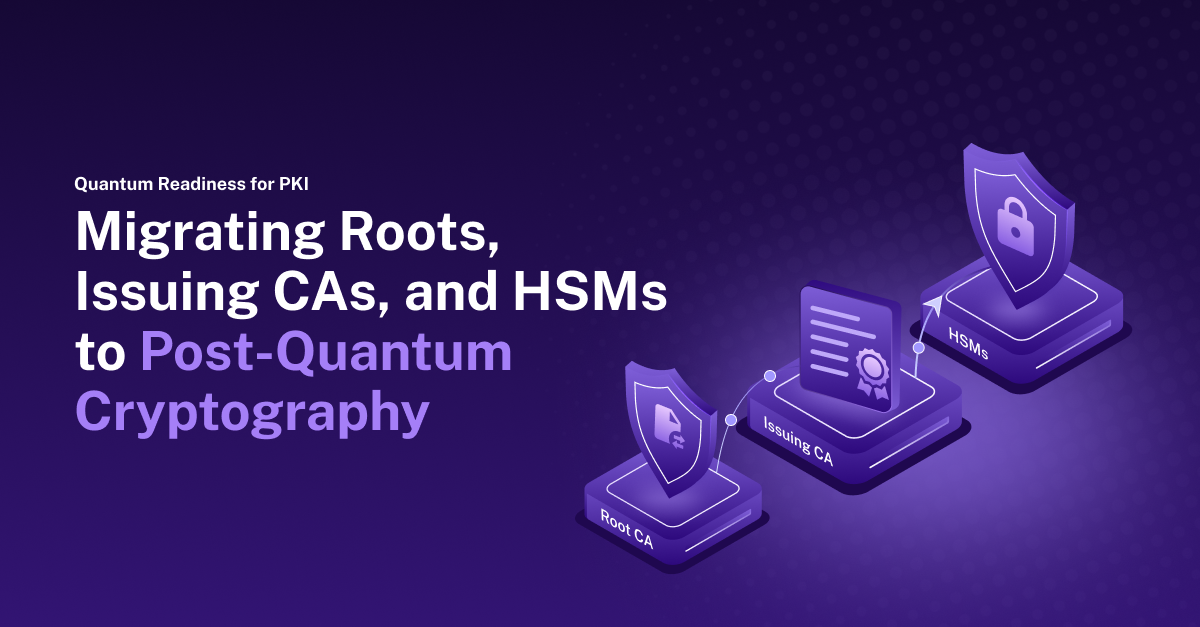
HSMs sit beneath PKI, code signing, KMS roots of trust, and most high-value cryptographic workflows. The PQC question for every HSM owner is specific: can firmware be upgraded in place, or does PQC support require hardware replacement? Modern HSMs from Entrust, Thales, Futurex, and others are designed with field-upgradable PQC firmware in mind. Legacy HSMs are increasingly a migration risk, particularly where hardware replacement cycles run five to seven years.
That hardware question is only the first dependency. PQC support cannot stop at the HSM boundary. PKCS#11, Microsoft CNG, Java Cryptography Architecture, and OpenSSL bindings must move in parallel. An HSM issuing ML-DSA signatures while its client libraries remain on RSA creates a security boundary at one layer and an unmanaged gap at the next.
Cloud KMS implications
Cloud KMS services are converging on the finalized standards. AWS KMS, Google Cloud KMS, and Azure Key Vault all have PQC support in production or preview, covering ML-KEM key agreement and ML-DSA signing. Organizations managing customer-controlled roots of trust need migration plans aligned with these timelines rather than treating cloud KMS as a separate workstream from on-premises cryptographic infrastructure.
TLS certificate lifecycles will shrink to 47 days by 2029
Shorter certificate validity periods are accelerating the need for automated certificate governance and crypto-agile infrastructure.
AI-Speed Attacks and the Crypto Control Plane
What changes when attackers move at machine speed
Finding and chaining implementation weaknesses across TLS libraries, certificate chains, and key management interfaces now runs at near-zero marginal cost using AI tooling. The detection-and-response models were built around an assumption that an alert would fire, a human would triage it, and a decision would be made before the attacker moved laterally. That window has closed now.
Quarterly certificate audits, annual key reviews, and periodic KMS access assessments were reasonable controls when threat actors moved at human speed. In a world where exploitation windows are measured in hours, those cadences belong to a threat model that no longer exists.
What this demands from the crypto control plane
A crypto control plane built for human-paced management creates an expanding gap between when a compromise becomes possible and when it gets detected. Closing it requires the same operating model the threat now runs on: continuous discovery, automated lifecycle management, inline policy enforcement at issuance, and HSM and KMS telemetry feeding into the SOC. Every AI agent your organization deploys adds a new credential pool to this estate. The discipline that secures it is the same discipline that secures any other machine identity.
A Unified Preparation Framework
The 47-day mandate, the PQC migration window, and the AI-speed threat model are not three separate work streams demanding three separate programs. They are three pressures converging on the same capability gap, and organizations that build automated, continuously verified, cryptographically agile machine identity infrastructure close all three with a single operational investment.
- Visibility across the full machine identity estate
You cannot automate what you cannot see, respond to what you have not inventoried, or migrate what you have not scoped. Your organization needs a single source of truth for every certificate, private key, and code-signing identity across public and private PKI, cloud workloads, Kubernetes, network appliances, and OT environments with ownership assigned to every machine identity. Discovery without ownership is a longer spreadsheet. It is not a security control.
- Automated lifecycle at machine speed
Manual certificate management is operationally unsustainable at 47-day lifetimes and a security liability at AI-speed threat timelines. You need programmatic enrollment across the full estate, ACME for public TLS, SCEP and EST for private PKI, native APIs for cloud and Kubernetes workloads, with algorithm, key length, validity period, and approved CA enforced at the point of issuance. Renewal, rotation, and revocation run under policy. Not through queues. Not through exceptions carved out because they were hard to automate.
- Crypto-agile HSM and KMS foundations
Your cryptographic roots of trust need to support the algorithms you will be required to run, not only the ones you currently use. HSMs need field-upgradable PQC firmware covering ML-KEM, ML-DSA, and SLH-DSA with FIPS 140-3 validation on the specific parameter sets your compliance requirements demand. KMS needs to issue, store, and rotate hybrid keys with policy-driven algorithm migration paths that propagate changes across the estate from a single control plane. The full stack should move together, or the upgrade creates a security boundary at one layer and an unmanaged gap at the next.
- Crypto telemetry into the SOC
Your HSM and KMS layer is already generating security signal: certificate expiry events, rotation failures, signing-rate anomalies, unusual key access patterns, off-hours KMS API calls. Most organizations are not listening to it. Routing that telemetry into SIEM and SOAR alongside endpoint and identity data is an instrumentation decision, not an architectural overhaul. The data is already there. The crypto layer is a detection surface. Treat it as one.
Final Thoughts
Organizations that treat the 47-day mandate as a compliance exercise, PQC migration as a 2030 planning item, and the Mythos announcement as a news cycle will address each of them reactively, sequentially, and behind the threat curve. The certificate-authentication bypass disclosed was evidence that cryptographic libraries are now subject to adversarial scrutiny at a scale and speed that changes the operating model.
Building automated, continuously verified, cryptographically agile machine identity infrastructure is the current cost of operating PKI, CLM, HSMs, and KMS in a defensible posture. The organizations that recognize the shared architectural answer and build it once are the ones positioned to absorb what comes next without doing it three times.
Accutive Security’s Center of Excellence in Cryptography, Identity Security, and Data Protection is equipped to help organizations move from assessment to implementation across all of these areas. If your organization needs a baseline assessment of its cryptographic posture, a readiness evaluation against the 47-day mandate, or a structured PQC migration roadmap, the expertise and certified partner relationships are in place to start.
Prepare your cryptographic infrastructure for AI and quantum-era threats
Strengthen PKI and crypto agility.





Leave a Reply