

Understanding what each regulation requires is a prerequisite, not the solution.
(For a full breakdown of major frameworks currently in force, see our companion guide: Global Data Privacy Regulations in 2026.)
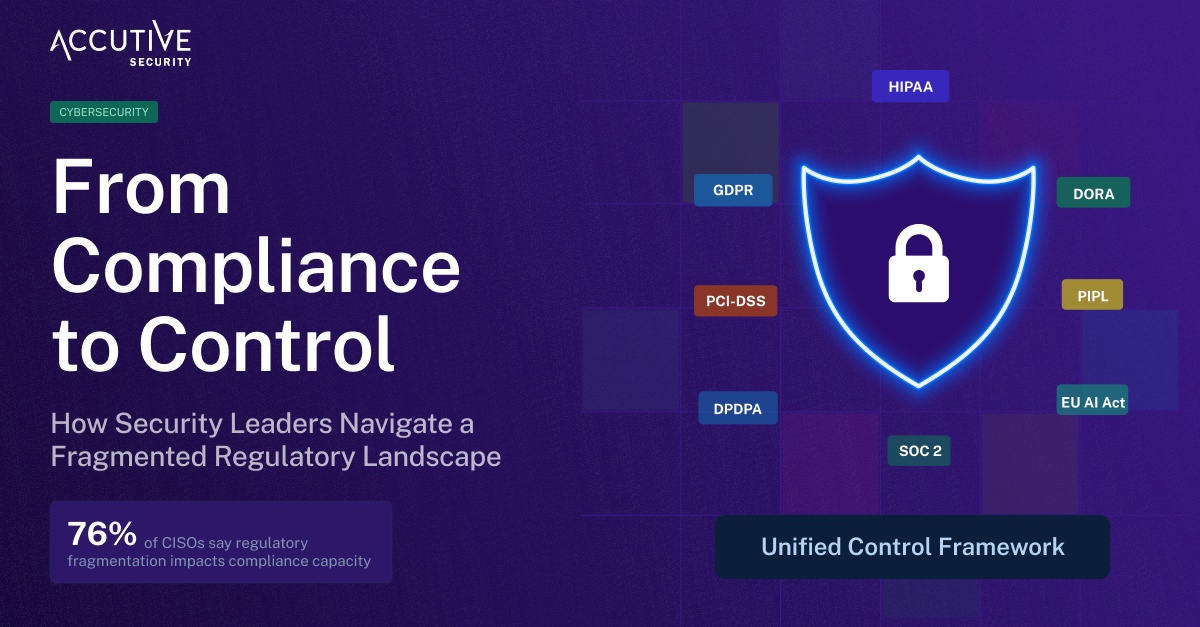
According to Coalfire, 47% of organizations reported failing a formal audit at least twice in the past three years, highlighting a major gap between risk awareness and operational capability. The underlying problem is that the global regulatory environment is no longer a collection of independent frameworks that can be addressed one at a time. According to the World Economic Forum’s Global Cybersecurity Outlook 2025, 76% of CISOs report that fragmentation of regulations across jurisdictions greatly affects their organizations’ ability to maintain compliance. That fragmentation is only going to compound as more jurisdictions pursue their own cybersecurity regulatory regimes.
The organizations that manage this effectively are not the ones with the most legal resources. They are the ones that have stopped treating compliance as a legal exercise and started treating it as an architectural one.
The Real Problem: Multi-Framework Compliance Complexity
The instinctive response to regulatory proliferation is to add resources: more legal counsel, more compliance staff, more point solutions for each new framework. That approach does not scale. Organizations that continue to layer headcount and tooling onto a fundamentally fragmented compliance approach will find the costs compounding without a proportional reduction in risk.
The root cause is structural. Multi-framework compliance produces three distinct and compounding layers of complexity.
- Overlapping Requirements
Most frameworks share the same foundational principles: consent, breach notification, data subject rights. The problem is execution. Breach notification alone requires notifying authorities within 72 hours under GDPR, 60 days under HIPAA, immediately under PCI-DSS 4.0, and “as soon as possible” under India’s DPDPA. An organization subject to all four does not have one breach response plan; it has four, each with different clocks, recipients, and legal consequences.
- Conflicting Obligations
Some conflicts create direct legal exposure. The GDPR mandates deletion of personal data used in AI training once its purpose is fulfilled, while the EU AI Act requires retention of that same data for system traceability and audit purposes. This is an example of a direct conflict with no clean resolution. Cross-border operations face the same tension: China’s PIPL demands data localization while GDPR governs outbound transfers, leaving multinational organizations navigating obligations that cannot both be fully satisfied simultaneously.
- Operational Fragmentation
When compliance is addressed framework by framework, each regulation generates its own implementation project, its own audit cycle, and its own evidence set. The same underlying control, for instance, encryption key management, gets documented and tested separately for every framework that requires it. Organizations managing compliance as disconnected workstreams will continue absorbing those costs.
What Regulations Actually Demand: The Technical Reality
Compliance today is best thought of as an architectural problem, rather than a legal one. An architectural problem only becomes solvable once you translate what regulations actually demand into the language of security controls.
Legal text rarely maps directly to a technical implementation. However, when you strip away the jurisdictional differences and read across frameworks, a consistent set of technical requirements emerges. The same controls appear in GDPR, DORA, HIPAA, PCI-DSS 4.0, PIPL, and the DPDPA, but described differently, enforced differently, but pointing toward the same underlying capabilities.
Here’s a quick reference guide:
| Regulatory Theme | What It Means | Technical Implementation |
| Data protection at rest and in transit | Sensitive data must be unreadable if storage or transmission is compromised | AES-256 encryption, TLS 1.3, HSMs for key protection |
| Cryptographic standards | Algorithms must meet regulatory minimums and remain auditable | FIPS 140-2/3 validated modules, algorithm inventory, PQC readiness, crypto agility |
| Access control and least privilege | Limit who accesses what, when, and under what conditions | PAM, IAM, just-in-time access, MFA enforcement |
| Machine identity governance | Non-human identities must be managed and audited with the same rigor as human identities | CLM, secrets management, certificate automation |
| Data lifecycle governance | Track, manage, and retire data and cryptographic keys across their full lifecycle | KMS, key rotation policies, data classification |
| Auditability and proof of compliance | Demonstrate compliance continuously, not just at audit time | Logging, SIEM integration, immutable audit trails |
| Breach detection and response | Identify, contain, and report incidents within prescribed timeframes | Monitoring, alerting, incident response automation |
Two insights from this table deserve emphasis.
- First, encryption is increasingly mandatory across major frameworks, including HIPAA, GDPR, and PCI-DSS. It is now a baseline expectation across virtually every active framework.
- Second, machine identity governance is more critical than ever as part of a comprehensive identity security framework. Every regulation that demands access control and audit logging implicitly demands that machine identities such as service accounts, certificates, API keys, application credentials be included in that governance scope.
The Only Scalable Approach: A Unified Control Framework
Across major regulations, the technical requirements converge on the same core domains: cryptography, identity, data protection, and auditability. Organizations that implement these domains as a unified architecture, rather than as separate compliance workstreams, satisfy multiple frameworks through a single, well-governed control layer.
This is the shift that separates organizations that are perpetually catching up from those that are structurally ahead of regulatory change. In 2026, modern compliance is defined by visibility, integration, and agility. Each of those three properties maps directly to a component of the unified control framework.
- Data-Centric Security: Protect the Data, Not Just the Perimeter
Perimeter-based security assumes that if the boundary holds, the data is safe. That assumption has not held for years. Data-centric security inverts the model: encrypt and govern the data itself, so that a compromised system does not automatically mean compromised data. Encryption at rest, tokenization of sensitive fields, and centralized key management ensure that data retains its protection regardless of where it moves, across cloud platforms, third-party environments, or jurisdictions with conflicting localization requirements.
- Identity-Centric Access: Human and Machine, Governed Equally
Every regulation that mandates access control is ultimately demanding the same thing: that only authorized identities — human and non-human — can reach sensitive data, and that every access event is logged and attributable. PAM governs privileged human access. Secrets management and CLM govern machine identity access. Together, they close the governance gap that most organizations have between their human identity programs and their frequently ungoverned machine identity estate.
- Crypto Agility: Built for Change, Not Just for Today
Regulatory requirements around cryptographic standards are not static. Algorithms that meet today’s compliance requirements are already on the deprecation timeline as PQC mandates accelerate. Crypto agility means building infrastructure that can rotate algorithms, update certificate templates, and migrate to new standards without rebuilding the architecture each time a regulatory threshold shifts.
- Automation: Because Compliance at Scale Cannot Be Manual
The 47-day certificate lifetime mandate, key rotation policies, access recertification cycles, breach notification clocks, none of these can be managed reliably at enterprise scale through manual processes. Automation is the reliable way forward for meeting the technical obligations that modern regulations impose.
Operationalizing Multi-Framework Compliance
Understanding the unified control framework as a concept is straightforward. Implementing it across a live enterprise environment with legacy infrastructure, siloed teams, and existing compliance commitments is where execution discipline matters.
The following steps provide a practical sequence for moving from a fragmented compliance posture to a control-based architecture.
1. Map Your Regulatory Obligations to a Common Control Layer
Before building anything, establish what you are actually required to do. Inventory every active regulatory obligation (by jurisdiction, by sector, by data type) and map each requirement to the technical control it demands. Breach notification requirements map to monitoring and alerting infrastructure. Encryption mandates map to key management and HSM capability. Access control requirements map to PAM and IAM. This mapping exercise will expose two things immediately: where you have genuine gaps, and where you are duplicating effort across frameworks that demand the same underlying control.
2. Classify and Inventory Sensitive Data Across All Environments
You cannot protect what you cannot see. Data classification is crucial for every downstream control decision. Encryption scope, access policy, retention schedule, and localization architecture all depend on knowing where sensitive data lives and how it flows. This includes cloud environments, SaaS platforms, development and test environments, and third-party systems. Unclassified data in a non-production environment is as much a compliance liability as unclassified data in production.
3. Implement Centralized Key Management
Encryption without centralized key management is incomplete compliance. Keys distributed across cloud providers, applications, and on-premises systems create the same fragmentation problem at the cryptographic layer that siloed frameworks create at the organizational layer. Centralized key management provides a single governance point for key generation, rotation, revocation, and audit logging across all environments simultaneously. This single capability satisfies encryption compliance requirements across GDPR, HIPAA, PCI-DSS 4.0, DORA, and PIPL without a separate implementation for each.
4. Enforce Least-Privilege Access Across Human and Machine Identities
Access governance must extend beyond human users. Implement PAM for privileged human access and automated secrets management and CLM for machine identity governance. Just-in-time access provisioning, where credentials are generated on demand and expire after use, eliminates the standing privilege exposure that most regulatory frameworks are specifically designed to address.
5. Automate Certificate Lifecycle and Key Rotation
Manual certificate management and key rotation are no longer operationally viable. With certificate lifetimes already reduced to 200 days and scheduled to reach 47 days by 2029, organizations that have not automated issuance, renewal, and revocation will face compounding operational failures. Automation also eliminates the human error factor in key rotation schedules, which is a documented source of compliance failures during audits. CLM platforms that support multiple certificate authorities and integrate with DevOps pipelines provide the automation layer that makes this sustainable at enterprise scale.
6. Build Audit Infrastructure That Works Across Frameworks
Compliance is only provable if the evidence exists in a format that satisfies the auditor in front of you. Build logging, monitoring, and reporting infrastructure that captures the right events like access attempts, key operations, certificate lifecycle events, and data subject requests in immutable, timestamped audit trails. The goal is a single evidence base that can be presented to different regulatory bodies in different formats, rather than rebuilding audit documentation for every framework separately. This is where compliance stops being a reactive exercise and becomes a continuous, demonstrable operational capability.
Conclusion: From Compliance to Control
The regulatory landscape will not simplify. New frameworks will take effect, existing ones will be amended, and enforcement will continue to intensify. Organizations that approach this reality by reactively adapting to each new obligation will always be behind.
The organizations that are ahead of this problem share a common characteristic: they stopped chasing regulations and started building architectures. They recognized that GDPR, DORA, HIPAA, PCI-DSS, PIPL, and most other global regulatory frameworks require the same actions: protect sensitive data, govern access to it, and prove that you have done both. That common demand has a common technical response: a unified control architecture built on cryptography, identity security, and data protection.
Building a multi-framework compliance architecture requires deep technical expertise across cryptography, identity security, and data protection, and the implementation capability to operationalize it across complex enterprise environments.
Accutive Security’s Center of Excellence brings both. As a specialist advisory and implementation partner, Accutive Security helps organizations design compliance architectures that satisfy multiple regulatory frameworks through a single, well-governed technical foundation.
Schedule a Cybersecurity Compliance Assessment with Accutive Security’s Center of Excellence and identify the gaps in your current control architecture before your next audit does.





Leave a Reply