

Choosing a Public Key Infrastructure (PKI) solution isn’t just about comparing features. Security and IT leaders face complex questions: How will the PKI integrate into existing systems? Can it handle the scale and automation demands of modern infrastructure? Will it remain secure and compliant as the cryptographic landscape evolves? These aren’t abstract concerns; they directly impact operational continuity, security posture, and future scalability.
Moreover, the rise of PKI-as-a-Service (PKIaaS) introduces new possibilities and trade-offs. Should you manage PKI in-house, or is a managed, subscription-based approach more efficient? This guide dives into these pressing questions, addressing the nuances of PKI selection to help you make a decision that aligns with your organizational goals and long-term strategy. This guide helps organizations evaluate public key infrastructure solutions based on scalability, automation, and integration requirements
Is Your PKI Ready? Get the Score
Quick self-assessment for CISOs/IT—see gaps and priority fixes.
What is PKI? Understanding Public Key Infrastructure
Public Key Infrastructure (PKI) is a cryptographic framework that establishes and manages digital trust within an organization. Despite PKI’s foundational importance to the cybersecurity and compliance programs of most organizations, it is often misunderstood. PKI refers to a set of technologies that use cryptographic keys and digital certificates to enable secure communications, data encryption, and authentication. At its core, PKI ensures that entities—whether people, devices, or applications—can communicate securely and verify each other’s identity.
What Are the Core Components of Public Key Infrastructure (PKI)?
PKI consists of several interdependent components that work together to provide security and trust:
- Certificate Authority (CA): The trusted entity that issues and manages digital certificates. The CA acts as a root of trust, verifying the identities of entities (users, devices, applications) before issuing certificates.
- Considerations: Internal vs. external CA, hierarchical vs. mesh CA architectures, certificate policies and practices.
- Digital Certificates: Electronic documents that bind a public key to an entity, serving as digital identities. Certificates enable secure communication and authentication by verifying the identity of the certificate holder.
- Types: X.509 certificates, TLS/SSL certificates, code signing certificates, S/MIME certificates.
- Key Management: Secure generation, storage, and management of cryptographic keys are crucial for protecting sensitive data and ensuring the integrity of the PKI system.
- Key Storage: Hardware Security Modules (HSMs), key escrow, key backup and recovery.
- Key Lifecycle Management: Key generation, distribution, rotation, and revocation.
- Certificate Lifecycle Management (CLM): Automating the processes of certificate discovery, issuance, renewal, and revocation is essential for operational efficiency and minimizing security risks. Effective PKI certificate management requires automation, visibility, and centralized control over certificate lifecycles.
- Automation: Automated enrollment, renewal, and revocation processes.
- Integration: Integration with directory services, network devices, and security tools.
- Hardware Security Modules (HSMs): These are hardened, tamper-resistant hardware devices specifically designed to secure and manage cryptographic keys. HSMs provide a high level of protection against unauthorized access and compromise, making them essential for safeguarding sensitive data and ensuring the integrity of the PKI system.
How is PKI Different from Certificate Lifecycle Management (CLM)?
While the terms are often used interchangeably, there’s a crucial distinction between Public Key Infrastructure (PKI) and Certificate Lifecycle Management (CLM). Think of PKI as the overarching system for establishing and managing digital trust, while CLM focuses specifically on the operational processes related to digital certificates within that system.
Here’s a breakdown:
PKI:
- Establishes the foundation of trust: PKI defines the policies, procedures, and technologies for managing digital certificates and cryptographic keys.
- Provides the infrastructure: This includes components like Certificate Authorities (CAs), Registration Authorities (RAs), and certificate repositories.
- Enables core security functions: Supports authentication, encryption, data integrity, and non-repudiation.
CLM:
- Focuses on certificate lifecycle operations: This includes certificate discovery, issuance, renewal, revocation, and monitoring.
- Automates certificate management tasks: Reduces manual effort, minimizes errors, and improves efficiency.
- Enhances security and compliance: Helps prevent certificate-related outages, security breaches, and compliance violations.
Why You Need Both:
While PKI and CLM are distinct concepts, they are intertwined and complementary. In fact, CLM is actually an essential component of a comprehensive PKI solution that is aligned with best practices. PKI establishes the overall infrastructure, policies, and procedures for managing digital certificates and cryptographic keys. It defines how certificates are issued, revoked, and used within your organization.CLM provides the operational capabilities to manage certificates throughout their lifecycle. This includes discovery, issuance, renewal, revocation and monitoring of all your organization’s internal and external certificates.
When using a PKI without a CLM solution, organizations often struggle with a variety of issues. The most common issues we see from organizations with an effective CLM are a lack of visibility, highly manual processes, insufficient compliance and high costs. Think of it this way: PKI provides the foundation and framework for digital trust, while CLM provides the tools and processes to manage and maintain that trust effectively.
For a deeper dive into the fundamentals, see our full guide on what PKI is in cyber security.
Comparing Enterprise PKI Solutions: Venafi, Keyfactor, AppViewX, DigiCert, Entrust, and HID
The PKI vendor market offers a number of trusted players, each tailored to specific use cases and organizational profiles. The following six vendors represent Accutive Security’s certified partner network in the PKI and machine identity space. Understanding how each solution is positioned helps organizations match their requirements to the right PKI vendor before initiating a formal evaluation.
CyberArk Identity Security (formerly Venafi)
Focus: Machine Identity Security as part of the CyberArk identity security portfolio. Venafi specializes in securing machine identities, including those used in cloud workloads, containers, and IoT devices. In 2024, Venafi was acquired by CyberArk, a global leader in identity and access management solutions such as privileged access management. With the Venafi acquisition, CyberArk has significantly bolstered their capabilities for securing machine identities, in addition to their longstanding strength with human identity security.
- Strengths: Automated certificate discovery and management, strong integration with DevOps tools and cloud platforms, robust security features. The integration with CyberArk’s suite of IAM tools provides a significant advantage for existing CyberArk customers.
- Best for: Organizations with large-scale deployments of machines and a need for automated certificate lifecycle management across complex environments.
Keyfactor
Focus: Scalable PKI solutions, including PKI-as-a-Service (PKIaaS), to simplify infrastructure management. Keyfactor is also a major contributor to and supporter of open-source PKI, particularly through its involvement with EJBCA and the PKI Consortium.
- Strengths: Centralized certificate management, automated certificate lifecycle automation, support for hybrid and multi-cloud environments, flexible deployment options.
- Best for: Organizations seeking a comprehensive PKI solution with flexible deployment options and strong automation capabilities.
AppViewX
Focus: CLM automation, PKI management, and cryptographic posture management. AppViewX is purpose-built for environments where certificate management needs to be deeply integrated with DevOps pipelines, cloud platforms, and network infrastructure. It is particularly strong in organizations preparing for the 47-day certificate mandate and post-quantum cryptography migration.
- Strengths: Workflow automation and orchestration for certificate provisioning, renewal, and revocation across complex multi-platform environments; Cryptographic Posture Management providing enterprise-wide visibility into weak algorithms, expiring certificates, and misconfigured CAs; strong DevOps and network infrastructure integration; multi-CA support.
- Best for: Organizations with complex, multi-platform environments seeking automation-first CLM, crypto agility, and cryptographic posture visibility. Particularly well-suited for teams facing the 47-day certificate mandate or planning a post-quantum migration.
DigiCert
Focus: The world’s largest commercial Certificate Authority and a leading provider of enterprise PKI and CLM solutions. DigiCert’s scale, browser trust, and CertCentral platform make it a critical partner for organizations that rely on publicly trusted certificates. DigiCert ONE brings together private CA, CLM, and device trust in a unified management experience.
- Strengths: Broadest range of publicly trusted TLS certificates (DV, OV, EV, wildcard); ACME protocol support for automated certificate issuance and renewal; enterprise CLM via CertCentral; IoT device identity management; strong compliance tooling.
- Best for: Organizations with high volumes of publicly trusted certificates, IoT device deployments, or those seeking unified public and private CA management experience with strong automation support.
Entrust
Focus: Digital trust infrastructure spanning PKI, Hardware Security Modules (HSMs), IAM, and identity verification. Entrust operates one of the world’s largest public certificate authorities and manufactures the nShield HSM product family, making it highly relevant to both the cryptography and identity security pillars of an enterprise security program.
- Strengths: Full-stack digital trust capabilities; nShield HSMs; enterprise PKI and private CA; certificate lifecycle management; phishing-resistant authentication (FIDO2, smart cards); strong regulatory compliance across government, healthcare, and finance.
- Best for: Regulated industries requiring deep HSM integration alongside PKI, or organizations seeking a single vendor for both cryptographic infrastructure and phishing-resistant workforce authentication.
HID Global
Focus: Identity and Access Management (IAM) with a strong emphasis on PKI for secure authentication and access control. HID’s solutions bridge the physical and digital identity worlds, providing technologies for building access, workforce authentication, and smart card issuance.
- Strengths: Robust authentication solutions; strong focus on compliance and security; expertise in industries with strict regulatory requirements (e.g., government, healthcare, finance); FIDO2/passkey hardware security keys.
- Best for: Organizations that prioritize phishing-resistant authentication and physical-digital identity convergence, and require a PKI solution that integrates seamlessly with their IAM infrastructure.
PKI Vendor Comparison: Features at a Glance
The table below provides a side-by-side comparison of leading enterprise PKI solutions across the criteria most relevant to procurement decisions.
Selecting the appropriate deployment model is crucial for balancing cost, control, and scalability.
| PKI Vendor | Deployment Model | Core Strength | CLM & CA Capabilities | Best Fit For | Accutive Certified Partner |
| CyberArk Venafi | Cloud, On-Prem, Hybrid | Machine Identity Security — certificate, secrets, and code signing management across cloud and DevOps environments | Full CLM (TLS Protect, Control Plane); private and public CA support | Large enterprises managing machine identities at scale across multi-cloud and hybrid environments; existing CyberArk PAM customers | ✓ |
| Keyfactor | Cloud (PKIaaS), On-Prem, Hybrid | PKI-as-a-Service and enterprise CLM, with deep expertise in IoT device identity and code signing governance | Full CLM (Keyfactor Command); enterprise CA (EJBCA); code signing (Signum); PKIaaS | Organizations with complex PKI requirements, IoT or device identity at scale, or mature code signing governance needs | ✓ |
| AppViewX | Cloud, On-Prem, Hybrid | CLM automation and orchestration with cryptographic posture management. Ideal for DevOps-heavy and network-centric environments | Full CLM (CERT+); private CA-as-a-Service (PKI+); workflow automation; multi-CA support; cryptographic posture visibility | Organizations preparing for the 47-day certificate mandate, post-quantum migration, or needing deep DevOps pipeline and network infrastructure integration | ✓ |
| DigiCert | Cloud (SaaS), Hybrid | World’s largest commercial Certificate Authority; enterprise CLM via CertCentral and DigiCert ONE for public and private certificate management | Enterprise CLM (CertCentral, DigiCert ONE); public CA — full range of TLS, code signing, S/MIME; private CA; IoT Trust Manager | Organizations with high volumes of publicly trusted certificates, IoT device identity requirements, or those seeking a unified public and private CA experience | ✓ |
| Entrust | Cloud, On-Prem, Hybrid | Full-stack digital trust infrastructure spanning PKI, HSMs, IAM, and identity verification — strong in regulated industries | Enterprise PKI and private CA; certificate lifecycle management; nShield HSMs (FIPS 140-2/140-3); public CA | Regulated industries (government, healthcare, finance) requiring deep HSM integration, phishing-resistant authentication, and a single vendor for PKI and IAM | ✓ |
| HID Global | On-Prem, Hybrid | Identity and Access Management with strong emphasis on PKI for physical and digital credential security, smart cards, and FIDO2 authentication | PKI for authentication use cases; smart card and PIV/CAC certificate management; FIDO2 and passkey support | Organizations prioritizing phishing-resistant authentication and physical-digital identity convergence, including government, healthcare, and enterprise access control | ✓ |
Note: Accutive Security holds certified service delivery status with all six vendors listed above. This means we have completed formal training and certification programs, maintain active relationships with channel and field teams, and are authorized to deliver implementations and managed services across all platforms.
Key Considerations for Evaluating Enterprise PKI Solutions
Each of the leading PKI solutions offers robust capabilities, but choosing the right platform requires more than a feature comparison. The following considerations will help organizations evaluate how well a solution aligns with their infrastructure, scales with growth, integrates with existing systems, and supports compliance and security objectives.
For most organizations that lack a mature PKI, starting with a comprehensive PKI assessment is recommended.
1. Considering Your PKI Architecture Needs
A well-designed PKI architecture is essential for meeting your specific security and compliance needs. Consider the following components:
- Certificate Authority (CA): Will you use an internal or external CA? How many CAs do you need? What trust model will you use (hierarchical, mesh)?
- Certificate Lifecycle Management (CLM): Choose a robust CLM solution to automate certificate management tasks and ensure visibility and control.
- Key Management System (KMS): Implement a secure KMS to protect your cryptographic keys.
- Hardware Security Modules (HSMs): Use HSMs to provide a high level of security for your most sensitive keys.
For most organizations that lack a mature PKI, starting with a comprehensive PKI assessment is recommended.
2. Avoiding Infrastructure Incompatibility
PKI solutions must seamlessly integrate with your existing IT ecosystem, which can include a mix of legacy systems, modern cloud platforms, and specialized devices. Incompatibility can lead to deployment failures, security gaps, and operational disruptions.
Integration Challenges:
- Legacy Systems: Integrating with older systems that lack modern APIs can require custom development or middleware solutions.
- Multi-Cloud Environments: Ensuring consistent certificate management across different cloud providers (AWS, Azure, Google Cloud) can be complex.
- IoT Devices: Many IoT devices have unique security requirements and may use lightweight protocols that require specialized PKI configurations.
Solutions:
- API-driven integration: Prioritize PKI solutions with robust APIs for integration with IAM systems, DevOps pipelines, SIEM solutions, and other critical tools.
- Backward compatibility: Ensure the PKI solution supports legacy systems and protocols.
- Cloud-native support: Choose a solution with native support for major cloud platforms and containerization technologies.
3. Finding the Right Deployment Model
Selecting the appropriate deployment model is crucial for balancing cost, control, and scalability.
| PKI Model | Pros | Cons |
| On-Premises PKI | Maximum control, compliance with strict data residency requirements. | High upfront costs, requires significant internal expertise, potential scalability limitations. |
| Cloud-Based PKI (PKIaaS)
Types: Managed PKI, Hosted PKI, Cloud-Native PKI |
Scalability, cost-effectiveness, reduced operational overhead, access to advanced features. | Potential data sovereignty concerns, vendor lock-in, reliance on provider’s security and SLAs. |
| Hybrid PKI | Combines the control of on-premises with the scalability of the cloud. | Increased complexity, requires careful planning to ensure seamless integration and synchronization between environments. |
PKIaaS simplifies deployment and management for organizations lacking in-house expertise. Providers like Venafi, Keyfactor, and HID offer PKIaaS solutions with customizable policies, automated updates, and compliance-ready configurations.
4. Ensuring Scalability and Automation
As organizations adopt DevOps, IoT, and multi-cloud strategies, the number of certificates grows exponentially. The pressure on certificate management operations has intensified significantly following CA/Browser Forum Ballot SC-081v3, which passed on April 11, 2025 and mandates a phased reduction of maximum TLS/SSL certificate validity. Phase 1 took effect on March 15, 2026, reducing the maximum certificate lifetime to 200 days. Organizations often struggle with how to manage PKI certificates efficiently without automation and centralized visibility.
The timeline ahead is demanding: by March 2027, the maximum validity drops to 100 days, requiring at least four renewals per certificate per year. By March 2029, the limit reaches 47 days, meaning organizations will need to renew certificates more than eight times annually. For any enterprise still relying on manual renewal processes or spreadsheet-based tracking, this trajectory makes CLM automation a non-negotiable operational requirement, not merely a best practice.
What to Look For:
- Does the PKI support a wide range of cryptographic algorithms, enabling you to quickly adopt quantum resistant cryptography?
- Does it support the unique requirements for IoT and mobile device certificates, including lightweight protocols and diverse formats?
- Can it scale to support thousands of certificates for IoT, cloud services, and internal devices?
- Does the PKI support high availability and disaster recovery to maximize reliability and performance?
- What monitoring and reporting capabilities does the PKI have?
Without automation, certificate renewal delays and expired certificates can lead to outages, security vulnerabilities, and compliance violations. Scalability ensures that the PKI can support increasing workloads without compromising performance.
CLM platforms such as Keyfactor, AppViewX, CyberArk Venafi, and DigiCert CertCentral are now essential infrastructure for any organization managing certificates at enterprise scale.
5. Staying Ahead of Compliance Requirements
Compliance is a moving target, with regulations like GDPR, FIPS 140-2, HIPAA, GLBA, and PCI DSS evolving regularly. A PKI solution that fails to adapt to new standards could leave your organization vulnerable to data breaches, fines and reputational damage.The rapid advancement of quantum computing presents major challenges for existing cryptographic algorithms underlying digital trust. Adopting crypto agility will enable your organization to quickly adopt new quantum-resistant algorithms as standards mature.
What to Look For:
- Pre-configured templates for compliance frameworks like GDPR or CMMC.
- Detailed audit trails that log certificate issuance, revocation, and lifecycle events.
- Reporting tools that simplify documentation for audits and regulatory submissions.
Regulatory non-compliance can result in significant penalties, reputational damage, and operational disruptions. Audit readiness requires detailed logging and reporting capabilities, along with built-in compliance configurations.
PKIaaS providers are increasingly embedding compliance features directly into their platforms, allowing organizations to outsource compliance maintenance and focus on operational goals.
6. Understanding Total Cost of Ownership (TCO)
The true cost of a PKI solution goes beyond licensing fees. You must account for deployment, customization, ongoing management, and scaling costs.
What to Consider:
- What are the upfront implementation costs, including integration with existing systems?
- How many certificates does your organization use now, and what is the projected usage in the future?
- How does the solution scale cost-effectively as your certificate needs grow?
Hidden costs, such as extensive customization or high support fees, can quickly turn an affordable solution into an expensive liability. PKIaaS offers a predictable subscription model, but can end up being more expensive than an on-premises solution in some cases. On-premises PKIs often have higher upfront costs but lower long-term expenses for organizations with stable infrastructures.
Build Before You Commit: Designing a PKI Proof of Concept (POC)
Do not make a costly mistake by choosing a PKI solution that does not meet your needs. A Proof of Concept (POC) allows you to test a PKI solution in a real-world environment before committing to a full-scale implementation. This helps you identify potential compatibility issues, performance bottlenecks, and missing features early on, saving time, money, and operational risk.
Accutive Security Innovation Lab: Your PKI Testing Ground
The Accutive Security Innovation Lab provides a controlled environment for conducting comprehensive POCs. Our lab mirrors your infrastructure, allowing you to test multiple PKI solutions, evaluate their performance, and ensure they integrate seamlessly with your existing systems.
Benefits of Using the Accutive Security Innovation Lab
- Accelerated Evaluation: Quickly test and compare different PKI solutions in a realistic environment.
- Reduced Risk: Identify potential issues and mitigate risks before making a significant investment.
- Hands-on Experience: Gain practical experience with the solution and its features.
- Improved Decision-Making: Make informed decisions based on real-world testing and evaluation.
- Faster Deployment: Reduce implementation time by familiarizing your team with the chosen solution in advance.
What you can expect at the Accutive Security Innovation Lab
- Hosted Lab Environments: Save time and resources by using fully equipped labs, avoiding the hassle of building your own setups.
- Realistic Testing: Simulate real-world scenarios to verify tool compatibility and prevent integration issues.
- Access to Leading PKI Solutions: Leading PKI solutions from global cybersecurity leaders like Keyfactor, Venafi, Thales and HID are pre-loaded in the Innovation Lab for demos, proof of concepts and testing.
- Product Demos: Experience solutions firsthand to see how they perform, enabling confident and informed decisions.
- Training: Train your team on the selected PKI solution, significantly reducing ramp-up time and ensuring a smoother deployment.
Start building a PKI proof of concept for free!
Scaling your PKI Architecture: From Single to Multi-Tier and Zero Trust PKI
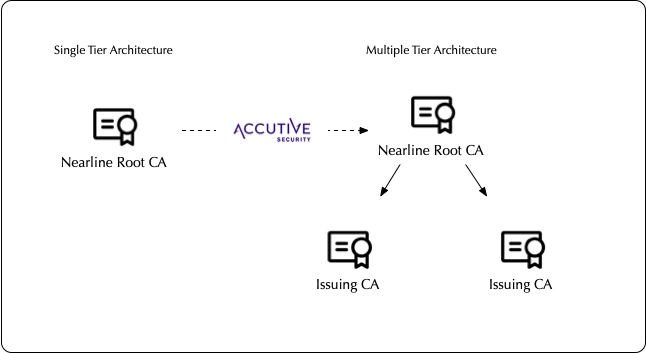
Single-Tier PKI
Traditional PKI often starts with a single-tier architecture, where a single Certificate Authority (CA) issues and manages all certificates for the organization. This approach is simple to implement but can become a bottleneck as the organization grows and the number of certificates increases.
- Limitations:
- Scalability: Limited scalability as the single CA becomes a central point of failure and performance bottleneck.
- Security: A single point of compromise can jeopardize the entire PKI system.
- Certificate Volume Concerns : Managing a large number of certificates with a single CA can be cumbersome and inefficient.
Multi-Tier PKI
To address these limitations, organizations often move to a multi-tier PKI architecture. This involves establishing a hierarchy of CAs, with a root CA at the top and subordinate CAs issuing certificates for specific departments, applications, or use cases.
- Benefits:
- Improved Scalability: Distributes the workload across multiple CAs, improving performance and resilience.
- Enhanced Security: Reduces the impact of a single CA compromise.
- Delegated Administration: Allows for decentralized certificate management, empowering different teams or departments to manage their own certificates.
- Increased Flexibility: Supports different certificate types and use cases with specialized CAs.
Zero Trust PKIaaS
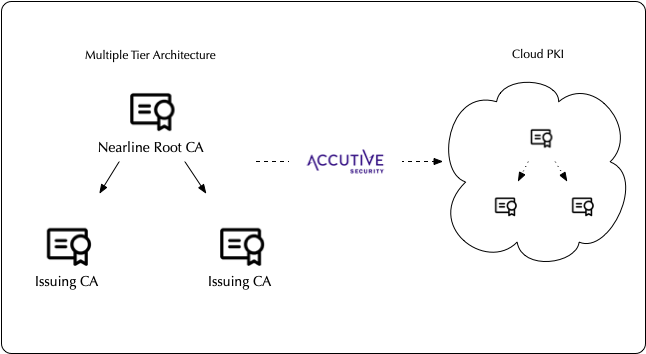
The rise of cloud computing, remote work, and sophisticated cyber threats has driven the adoption of Zero Trust security frameworks. Zero Trust PKIaaS takes PKI to the next level by integrating it with a Zero Trust security model.
Key Principles:
- Never trust, always verify: Every user, device, and application must be authenticated and authorized before accessing resources.
- Least privilege access: Grant only the minimum necessary permissions to users and devices.
- Continuous monitoring: Continuously monitor and verify access to detect and respond to threats in real-time.
Benefits of Zero Trust PKIaaS:
- Enhanced Security: Reduces the attack surface and mitigates the risk of lateral movement in case of a breach.
- Improved Compliance: Helps meet regulatory requirements for strong authentication and access control.
- Simplified Management: Leverages the scalability and flexibility of cloud-based PKIaaS solutions.
- Reduced Operational Costs: Minimizes the need for on-premises infrastructure and dedicated PKI expertise.
How to Evaluate PKI Vendors: Choosing a Solution That Scales with Your Needs
When choosing among enterprise PKI solutions, it is essential to look beyond basic features and consider the broader needs of your organization. The following key takeaways should guide your decision:
- Think Long-Term: Select a solution that can adapt to your organization’s evolving needs, including future growth, new technologies, and changing security threats.
- Prioritize Scalability and Automation: Ensure the solution can handle increasing certificate volumes and automate certificate lifecycle management to minimize risks and improve efficiency.
- Embrace Cryptographic Agility: Choose a solution that supports a wide range of cryptographic algorithms and can adapt to new standards as they emerge, especially given the trajectory toward post-quantum cryptography.
- Address Compliance Requirements: Ensure the solution helps you meet relevant regulatory requirements and industry standards, such as FIPS 140-2, HIPAA, PCI DSS, and others.
- Consider Deployment Flexibility: Evaluate different deployment models (on-premises, cloud-based, or hybrid) and choose the one that best aligns with your organization’s needs and risk tolerance.
- Do Not Underestimate Integration: Ensure seamless integration with your existing infrastructure, including legacy systems, cloud platforms, and security tools.
- Conduct Thorough Testing: Perform a Proof of Concept (POC) to validate the solution’s capabilities and compatibility with your environment.
Why Partner with Accutive Security for PKI Implementation
Selecting the right PKI solution is only half of the decision. The implementation, integration, and ongoing operational management of a PKI platform are where organizations most commonly encounter risk. This is where Accutive Security’s Center of Excellence in Cryptography, Identity Security, and Data Protection comes in.
Accutive Security operates as a certified services partner, not just a reseller, for the leading PKI and CLM platforms covered in this guide. That distinction matters. Our team has completed formal certification programs with Keyfactor, CyberArk Venafi, AppViewX, DigiCert, Entrust, and HID, and holds active delivery relationships with each vendor’s field and channel organizations. This means we can implement and operationalize the solutions we recommend, and our advice is grounded in hands-on deployment experience across financial services, healthcare, retail, insurance, telecommunications, and the public sector.
How Accutive Security Supports PKI Programs
Our engagement model covers the complete PKI lifecycle:
- Solution Selection and Vendor-Agnostic Advisory: We assess your environment, requirements, and constraints to identify the right PKI vendor and deployment model. Because we carry multiple competing platforms, our recommendations are based on client fit, not vendor preference.
- Proof of Concept via the Innovation Lab: We run PKI POC engagements in our Innovation Lab, providing hands-on validation before your organization commits to a platform or investment.
- Implementation and Integration: End-to-end deployment of PKI and CLM platforms, including architecture design, system configuration, integration with ITSM, SIEM, DevOps pipelines, directory services, and cloud platforms.
- Managed Services: Ongoing operational management of PKI platforms, including monitoring, patching, incident response, and certificate lifecycle operations.
- Health Checks and Assessments: Deep technical reviews of existing PKI deployments to identify gaps, misconfigurations, and optimization opportunities.
- Platform Upgrades and Migrations: Managing version upgrades, cloud migrations, and architecture modernization for organizations transitioning from legacy PKI infrastructure.
- Technical Account Management and Staff Augmentation: Dedicated senior technical resources embedded with your team, providing strategic continuity during peak demand or skills gaps.
Accutive Security holds a 5-star rating as a Highest Rated Security Services Provider on Gartner Peer Insights, reflecting the depth and quality of our delivery model across client engagements.
Making Your PKI Decision
By carefully evaluating PKI vendors against the criteria outlined in this guide, organizations can build a confident, evidence-based shortlist. The key is to move from feature comparison to operational alignment: which solution will your team be able to implement, manage, and scale effectively over a multi-year horizon?
With CA/Browser Forum Ballot SC-081v3 Phase 1 already in effect and the 47-day certificate mandate on the horizon by 2029, the window for reactive PKI strategy is closing. Organizations that establish robust PKI foundations today, supported by CLM automation and cryptographic agility, will be significantly better positioned for the compliance and operational challenges ahead.
Ready to evaluate your PKI options?
Schedule a consultation with Accutive Security’s PKI specialists. We will assess your current environment, identify the right enterprise PKI solution for your requirements, and walk you through a live proof of concept in our Innovation Lab before you commit to a platform.

Comment